
Walk into a perfume store or browse a fragrance website and you will quickly come across terms such as Eau de Parfum, Eau de Toilette and Parfum.
For someone new to fragrances, these names can be confusing. They may sound like different styles of perfume, but they primarily describe the concentration and format of a fragrance.
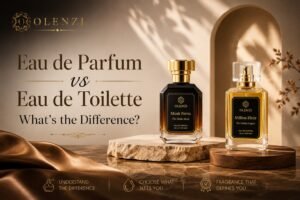
So, what is the difference between Eau de Parfum and Eau de Toilette?
The simplest answer is that Eau de Parfum, commonly abbreviated as EDP, is generally formulated with a higher concentration of aromatic materials than Eau de Toilette, commonly called EDT. However, concentration is only one part of the fragrance experience.
The formula itself, the ingredients used, your skin, the environment, application and even your personal perception can influence how a perfume smells and performs.
Understanding the difference between EDP and EDT can therefore make perfume shopping much easier. Instead of choosing a bottle simply because one label sounds stronger, you can make a decision based on how and where you actually want to wear the fragrance.
What Does Eau de Parfum Mean?
Eau de Parfum is usually abbreviated as EDP.
The term refers to a fragrance format that generally contains a higher concentration of aromatic compounds than Eau de Toilette. Because of this, an EDP can often have a richer or more substantial fragrance presence.
But there is an important point to remember: there is no single universal concentration percentage that applies to every EDP on the market.
Different fragrance houses can formulate their perfumes differently, which means you should not assume that every Eau de Parfum will smell equally strong or last for exactly the same amount of time.
An EDP can be a good choice for someone who enjoys a fragrance with a more noticeable presence, particularly when the composition and wearing situation suit it.
What Does Eau de Toilette Mean?
Eau de Toilette, or EDT, is another common fragrance format.
Compared with Eau de Parfum, EDT is generally formulated with a lower concentration of aromatic materials. This can contribute to a lighter impression, although the final character depends heavily on the actual fragrance formula.
An EDT is not simply a “weaker perfume.”
That is an important distinction.
A well-designed Eau de Toilette can have its own character, development and appeal. Some people may actually prefer the way an EDT feels on the skin, especially when they want something that feels lighter or more refreshing.
The concentration is part of the story, not the entire story.
Eau de Parfum vs Eau de Toilette at a Glance
The basic comparison looks like this:
Eau de Parfum (EDP)
Generally higher concentration of aromatic materials. Often chosen by people looking for a richer fragrance presence.
Eau de Toilette (EDT)
Generally lower concentration of aromatic materials than EDP. Often associated with a lighter fragrance experience.
However, this should not be interpreted as a universal rule that EDP is always better, stronger or longer-lasting than EDT.
The actual fragrance formula matters.
Two perfumes with different concentrations can perform very differently because the materials and composition themselves influence the result.
Does Eau de Parfum Last Longer Than Eau de Toilette?
This is probably the most common question people ask when comparing EDP vs EDT.
The answer is: not necessarily in every situation.
A higher concentration can contribute to a longer-lasting fragrance experience, but concentration alone does not determine longevity.
Other factors include:
- The fragrance formula
- The materials used
- Your skin
- Your body temperature
- Weather and humidity
- How much fragrance you apply
- Where you apply it
- Your individual body chemistry
This is why one Eau de Toilette can sometimes remain noticeable longer on a particular person than another Eau de Parfum.
It is also why buying a fragrance based purely on the words “Eau de Parfum” is not enough.
If fragrance longevity is particularly important to you, it is better to consider the complete fragrance experience rather than relying on concentration alone.
For more practical advice, you can also read OLENZI’s guide on how to make your perfume last longer.
Is Eau de Parfum Stronger Than Eau de Toilette?
Generally, EDP can have a more concentrated fragrance presence than EDT.
But “stronger” can mean different things.
Someone might use the word stronger to describe:
- How noticeable a perfume is immediately after spraying
- How long the scent remains detectable
- How much fragrance surrounds the wearer
- How rich or intense the composition feels
- How much it projects into the surrounding space
These are not exactly the same thing.
A fragrance can be highly concentrated without being aggressive. Another fragrance can project noticeably even though it is not an EDP.
This is why fragrance terminology should be understood rather than treated as a simple ranking system.
Does EDP Always Smell Richer Than EDT?
Not automatically.
An EDP can feel rich, deep or substantial, but that depends on the fragrance composition.
For example, a fragrance built around warm, sweet or woody characteristics may naturally feel more substantial than a fresh composition, regardless of whether you are comparing different concentration formats.
The personality of the fragrance matters.
If you already know that you enjoy a particular fragrance family, that preference can be more useful than simply choosing EDP because it sounds more concentrated.
If you’re still discovering your personal preferences, our guide on finding your signature scent can help you think about fragrance as part of your personal style.
When Should You Choose Eau de Parfum?
Eau de Parfum can be a good choice when you prefer a more concentrated fragrance format and want a fragrance that feels substantial as part of your overall presence.
For example, you might prefer EDP when:
- You enjoy a noticeable fragrance character
- You are building a small fragrance wardrobe
- You want a fragrance that can transition from daytime into evening
- You prefer richer fragrance experiences
- You want to explore a more concentrated format
That does not mean EDP is automatically the right choice for everyone.
Your personal preference should remain the deciding factor.
When Should You Choose Eau de Toilette?
EDT can appeal to someone who prefers a lighter fragrance experience or simply enjoys the character of a particular EDT composition.
It may be worth considering when:
- You prefer a lighter-feeling fragrance
- You enjoy fresh or easygoing fragrance styles
- You want something that fits naturally into your daily routine
- You prefer a less concentrated format
- You simply like the particular scent more than its concentration label
There is no rule that says every fragrance enthusiast needs to prefer EDP.
Fragrance is personal, and the best choice is the one that fits the way you actually want to wear it.
EDP vs EDT for Everyday Wear
For everyday fragrance, think beyond concentration.
Ask yourself where you spend most of your time.
If you work in an office, attend university, travel frequently or spend a lot of time around other people, your ideal fragrance may be one that feels comfortable and appropriate for your environment.
On the other hand, if your routine often includes dinners, evening gatherings or formal events, you may naturally prefer a fragrance with a richer character.
This is why building a fragrance wardrobe can be more useful than searching for one “best” concentration.
You might eventually discover that different fragrance formats suit different parts of your lifestyle.
For more guidance on matching fragrance to situations, see OLENZI’s article on choosing the right perfume for every occasion.
How Weather Can Change Your Fragrance Experience
The climate around you matters when wearing perfume.
Warm weather can influence fragrance evaporation and projection, while cooler conditions can change the way a fragrance develops and feels in the air.
This is particularly relevant for fragrance shoppers in Pakistan, where temperatures and weather conditions can vary significantly throughout the year.
Instead of asking only, “Is EDP better than EDT?” consider asking:
How does this fragrance feel in the environment where I will actually wear it?
That is a much more useful question.
A fragrance that feels comfortable in a cool evening may feel considerably more noticeable during a hot afternoon.
The concentration is worth understanding, but the complete wearing environment matters too.
How Your Skin Affects Perfume
Perfume does not smell exactly the same on everyone.
Your skin, body temperature, environment and individual body chemistry can influence how a fragrance develops.
This is one reason fragrance testing is so valuable.
A perfume that smells excellent on a paper strip may develop differently once applied to your skin.
Give the fragrance time.
Notice the opening.
Then pay attention as it develops.
Finally, consider the dry down.
This gives you a much better understanding of whether the perfume actually suits you.
Why Testing a Perfume Before Buying Can Help
When choosing between fragrances, testing gives you an opportunity to experience the perfume rather than judging it entirely from its description.
This can be especially useful if you are deciding whether a particular fragrance belongs in your regular rotation.
You can wear it during your normal routine and observe:
- How the opening feels
- How the fragrance develops
- How comfortable it feels throughout the day
- How it interacts with your skin
- Whether you genuinely enjoy wearing it
OLENZI offers a dedicated perfume tester collection for fragrance enthusiasts who want to explore scents before committing to a full-size bottle.
The current OLENZI Premium Tester Kit is listed as 2 × 10ml Eau de Parfum testers, designed for discovering and comparing fragrances before purchasing a full-size bottle.
How EDP Applies to the OLENZI Collection
Understanding concentration becomes more practical when you look at actual fragrance products.
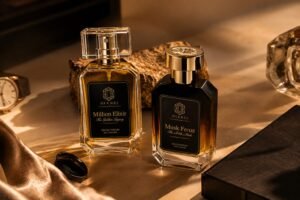
For example, OLENZI’s Million Elixir – The Golden Legacy is listed as a 50ml Eau de Parfum for men. Its published fragrance profile includes vanilla, fruity, rose, sweet, woody, green, powdery, balsamic, floral and aromatic facets.
That gives a useful real-world example of an EDP: the concentration format is one part of the product, while the fragrance profile itself determines much of its personality.
You can explore OLENZI Million Elixir if you want to see the full product information.
Another example is Musk Feroz – The Noble Musk, which OLENZI lists as a 50ml Eau de Parfum for men. Its published description focuses on a warm, smooth and sophisticated musky character.
You can explore OLENZI Musk Feroz for the complete product details.
These examples also demonstrate an important point: knowing that a perfume is EDP tells you something about its format, but you still need to understand the fragrance itself.
Is Eau de Parfum Better Than Eau de Toilette?
There is no universal winner.
If you prefer a more concentrated format, EDP may be more appealing.
If you prefer a lighter fragrance experience, EDT may suit you better.
But even that comparison is incomplete because fragrance personality matters.
Imagine two perfumes:
One is an EDP with a fragrance character you do not enjoy.
The other is an EDT with a scent profile that immediately feels right to you.
Which one is better?
For you, probably the EDT.
The best perfume is not determined by the label alone. It is the fragrance you genuinely enjoy wearing.
Common Mistakes When Choosing Between EDP and EDT
Choosing EDP simply because it sounds stronger
Higher concentration does not automatically mean better.
Assuming EDT means poor quality
Eau de Toilette is a legitimate fragrance format, not an inferior version of perfume.
Judging performance from concentration alone
Concentration is only one factor among many.
Buying without testing when testing is possible
Your skin can reveal a different experience from a paper strip or description.
Ignoring your environment
Weather, surroundings and occasion can all influence how a fragrance feels.
Choosing based entirely on popularity
A popular fragrance may not match your personal preferences.
How to Decide Between EDP and EDT
If you are standing in front of two fragrances and cannot decide, use this simple process.
First, smell both.
Pay attention to which fragrance immediately appeals to you.
Second, test them on your skin if possible.
Your skin provides a more realistic experience than judging a fragrance entirely from the bottle or packaging.
Third, give them time.
Do not make your final decision only from the first few moments.
Fourth, consider where you will wear the fragrance.
Think about work, daily routines, social events, evenings and special occasions.
Finally, choose the fragrance you actually enjoy.
Do not let EDP or EDT make the decision for you.
The concentration should inform your choice, not replace your personal judgment.
Should You Build a Fragrance Wardrobe Around EDP or EDT?
You do not need to choose only one.
A fragrance wardrobe can include different formats depending on your preferences.
You might eventually have:
- One everyday fragrance
- One fragrance for formal occasions
- One evening fragrance
- One warmer-weather option
- One cooler-weather option
- A tester selection for exploring new scents
There is no required number of perfumes.
The goal is simply to have fragrances that fit different moments in your life.
The Most Important Thing to Remember
When comparing Eau de Parfum vs Eau de Toilette, remember that concentration is useful information, but it is not the complete story.
EDP generally has a higher concentration of aromatic materials than EDT.
EDT generally uses a lower concentration.
But fragrance performance, character and overall experience depend on much more than the concentration label.
The formula matters.
Your skin matters.
The weather matters.
Application matters.
And, perhaps most importantly, your personal preference matters.
If a fragrance makes you feel comfortable, confident and naturally yourself, that is far more meaningful than choosing a bottle simply because its concentration sounds more powerful.
Conclusion
Understanding the difference between Eau de Parfum and Eau de Toilette makes perfume shopping less confusing.
EDP and EDT are different fragrance formats, with EDP generally having a higher concentration of aromatic materials. But that does not make one universally better than the other.
Instead of asking only whether EDP is stronger than EDT, think about the complete fragrance experience.
What does the perfume smell like?
How does it develop on your skin?
When do you want to wear it?
How does it fit your lifestyle?
And most importantly, do you genuinely enjoy it?
Those questions will lead you toward a fragrance that feels right for you.
When you’re ready to explore fragrances for yourself, you can browse the OLENZI Collection or start with OLENZI Testers if you want to experience fragrances before choosing a full-size bottle.
FAQ SECTION
Is Eau de Parfum stronger than Eau de Toilette?
Eau de Parfum generally contains a higher concentration of aromatic materials than Eau de Toilette, so it can have a more concentrated fragrance presence. However, the actual strength and performance depend on the fragrance formula, application, skin and environment.
Which lasts longer, EDP or EDT?
EDP can often provide a longer-lasting fragrance experience because of its generally higher concentration, but this is not guaranteed. The formula, skin chemistry, weather and application can all influence how long a fragrance remains noticeable.
Is Eau de Parfum better than Eau de Toilette?
Neither is universally better. EDP may suit someone who prefers a more concentrated fragrance format, while EDT may appeal to someone who prefers a lighter fragrance experience. Personal preference should be the deciding factor.
Can I wear Eau de Parfum every day?
Yes. An Eau de Parfum can be suitable for everyday wear when its fragrance character and application suit your environment. Consider your workplace, weather and how noticeable you want your fragrance to be.
Why does the same perfume smell different on different people?
Fragrance can develop differently depending on skin, body temperature, environment and individual body chemistry. This is why testing a perfume on your own skin can be more useful than judging it solely from a description or someone else’s experience.
Should I test a perfume before buying it?
If possible, testing is a useful way to understand how a fragrance develops on your skin and whether you genuinely enjoy wearing it. OLENZI’s tester collection is designed for exploring fragrances before purchasing a full-size bottle.


One Response
Very informative